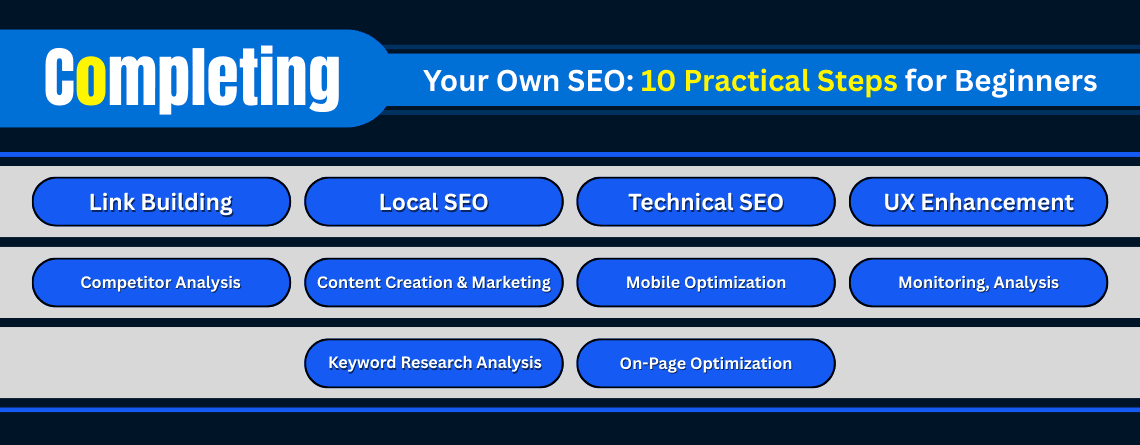
Completing your own SEO means taking control of how your website appears in search engines and improving its visibility without relying entirely on external help. For many website owners and small businesses, this is a practical and achievable approach when done correctly. However, SEO often feels confusing because it involves multiple steps, ongoing optimisation, and understanding how search engines evaluate websites.
This guide breaks down the process into 10 clear, practical steps that show you exactly how to complete your own SEO from start to finish. It explains what actions to take, why each step matters, and how they work together to improve rankings, organic traffic, and overall website performance. Whether you are new to SEO or looking to strengthen your existing efforts, this article provides a straightforward, beginner-friendly roadmap to doing SEO the right way.
Is It Really Possible to Complete Your Own SEO?
Yes, it is absolutely possible to complete your own SEO, provided you understand the fundamentals and are prepared to apply them consistently. DIY SEO works best for small to medium-sized websites, local businesses, and service-based companies that want steady, long-term growth rather than instant results.
However, completing your own SEO requires time, learning, and patience. Search engine optimisation is not a one-off task but an ongoing process. When done correctly, it helps search engines understand your website, trust your content, and rank your pages for relevant searches.
Step 1: Understand How Search Engines Work
Before starting any SEO activity, it is essential to understand how search engines process websites. Search engines such as Google rely on three core processes:
- Crawling – discovering pages through links and sitemaps
- Indexing – storing and organising content in a database
- Ranking – displaying pages based on relevance, quality, and usefulness
SEO exists to make your website easier to crawl, index, and rank. Without this understanding, many DIY SEO efforts focus on the wrong actions and deliver poor results. Knowing how search engines work allows you to prioritise tasks that actually impact visibility.
Step 2: Carry Out Keyword Research for DIY SEO
Keyword research is the foundation of completing your own SEO. Keywords tell you what users are searching for and how they phrase their questions.
Effective keyword research involves identifying terms that are:
- Relevant to your business
- Realistically achievable
- Aligned with user intent
Focus on a mix of short and long-tail keywords. Long-tail keywords are especially valuable for DIY SEO because they are more specific and usually less competitive. Instead of targeting broad terms, aim for keywords that match real problems and questions your audience is searching for.
Avoid keyword stuffing. Keywords should appear naturally in your content, headings, and metadata, not forced into every sentence.